"The whole aim of practical politics is to keep the populace alarmed (and hence clamorous to be led to safety) by menacing it with an endless series of hobgoblins, all of them imaginary." ~ H.L. Mencken

Why and How the West Is Hoist by Its Own Petard: A Book Review
Osama: The Making of a Terrorist 
by Jonathan Randal
Knopf, 339 pp., $26.95
When I was taking the Infantry Officers Foreign Weapons Course during my military service, I heard this story from a weapons instructor (which I found hilarious at the time), about some clandestine North Korean intel agents who were sent to a guerilla outpost in Peru to do weapons instruction and training.
One of the weapons they were instructing on was the Soviet-designed B-10 recoilless rifle. Now for the uninitiated, the B-10 is in essence a single shot, single tube, rocket launcher, with a rifled barrel. It has no "recoil" because the flame and superheated gas from the launch comes out of the reverse end of the tube. Used properly, it is a devastating short range direct fire weapon.
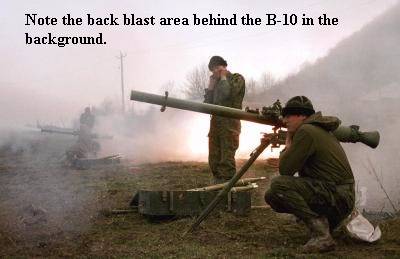 The funny part is that all the NKA's instruction kinda came to naught when the poobahs and bigshots set up their observation stand less than 10m and directly behind the "back blast area" (i.e. - the minimum distance required to be safe from the ignition flame and superheated gases generated when a weapon is fired).
Being in that backblast area can and will cause serious injury or death. And it did in this case too, apparently, when the guerilla team test fired its B-10 . . . and in one shot killed or seriously burned the entire provincial leadership cadre for the Shining Path Movement guerilla army in Peru . Something the CIA , multiple US Army Special Forces A-Teams, and the entire Peruvian military and police, not to mention numerous rival guerilla and bandit groups, and even bounty hunters in the pay of plantation owners had all failed to accomplish in several years. My instructor just laughed his ass off (and so did all of us student officers as well). It seems that the Sendero Luminoso were hoist by their own petard as it were. The instructor's more serious point was this: When deploying weapons, beware of your own backblast!
This point was rather lost during the early years of the Reagan Administration in the early 1980s and beyond. It seems that in order to stick it to the Brezhnev Doctrine and the Soviet state that implemented this policy (as a counter to the United States' and the West's Containment Policy), the US government poured billions of dollars, tons of weapons, ammunition, and equipment into Afghanistan to train and equip anti-Soviet resistance groups. The CIA sponsored and paid for instruction camps that were established in Pakistan . Jonathan Randal says in his book that these efforts were a great success.
And so it seems too. Within a decade these guerillas, the Mujahideen ("fighters"), had driven the Soviet Army back across the border into Soviet Central Asia and deposed the local puppet regime they had put in place.
The downside of all this as Randal notes was the creation, at US taxpayers' expense, of the Islamic guerilla force known today as al-Qaida. The rest of that history and its consequences for the world we already know. Al-Qaida under the leadership of Osama bin-Laden is pinpricking the US giant steadily and deliberately and in so doing are moving America and the West in the direction they want them to go in.
"To an extent," says Randal, " America has fallen into precisely the trap that the September 11 attackers believed they were setting. It has created new enemies. It has alienated old friends." And as the recent London bombings show, this is all part of the plan, such as it may be. This is the book's thesis, which Randal presents clearly and with good supporting detail.
Randal's book does have its shortcomings, however. He can't make up his mind if he wants the form of the book to be either a first draft screenplay like Mark Bowden's Blackhawk Down was, or to be a more scholarly work like Chalmers Johnson's Blowback was. It veers back and forth between these two poles and is a lesser work because of the inability to be one or the other.
The other drawback for Randal's book is that he failed to accomplish a face-to face-meeting with bin-Laden. Osama did apparently take written questions from Randal, passed back and forth by intermediaries, but he never got the coveted face time. Even one short personal interview, as any decent reporter or biographer can attest, is invaluable, for it gives the writer a chance to see the subject as they are rather than as the rumors, spin, and propaganda portray them to be.
Despite these and the shortcomings previously noted, the book does shed light into the nuances of the Islamist mindset, which should be helpful to the interested reader without being excessively detailed and which often bogs down the narrative flow.
In the end, Osama: The Making of a Terrorist is a worthwhile read for the layman, but if a very thorough and scholarly work on the details of Islamist politics and the life of Osama bin-Laden is wanted or required, other books would be a better choice.



 Print
PrintUser Login
Search This Site
Recent comments
-
No real surprise.
-
https://gx2527leftinvietnam.com/
-
https://www.infowars.com/posts/alert-col-macgregor-warns-dem...
-
And of course, both of the author/commentators are Jews. No...
-
Surprised to see Switzerland at only 32/100. Would've be...
-
https://www.infowars.com/posts/johns-hopkins-says-gun-contro...
-
An early Christmas present, it seems -- here, some 17 years...
-
Never Forget Building 7: https://www.infowars.com/pos...
-
Straight out of the communist playbook, as per Saul Alinsky...
-
It's certainly a step in the right direction.
more

Root Strikers
Non-Voting

Civil Disobedience





 Reprint Rights