"The whole aim of practical politics is to keep the populace alarmed (and hence clamorous to be led to safety) by menacing it with an endless series of hobgoblins, all of them imaginary." ~ H.L. Mencken

Thucydides' Law
Exclusive to STR
' it is a general and necessary law of nature to rule whatever one can. ~ Thucydides
The growth of the state with its government apparatus has resulted in the growth of coercion, the growth of force. When all of the layers of government are peeled back to reveal its inner core, its essence, that essence is force. This fact is hardly a secret. A college text in political science will define government as that entity which has a monopoly on the use of coercion within a given geographic area. This growth of governmental force acts as a heavy saddle on your back as you are coerced to comply with statues, mandates, regulations, tax codes, military drafts, government service, labor laws, licenses ' indeed, the whole range of government trespass into your private and personal life. It is a heavy burden and will only get heavier until some intervention takes place.
This essay will briefly explore three of the mechanisms the state uses to expand its force over civil society and individual liberty. The mechanisms will be presented as models in the form of flow charts, i.e., simplified representations of reality. We will begin with an overview examining civil society and its greatest threat, political society.
Transforming Civil Society into Political Society
Over two thousand years ago the Greek philosopher and historian Thucydides wrote in the History of the Peloponnesian War that power always expands to control what it can. Nowhere is this observation more apparent than in the growing power of the state. State power always expands at the expense of civil society. A civil society is characterized by voluntary exchange and associations operating within those markets, organizations, movements and networks that live and work in the social space outside the control of the state. Civil society encompasses much of our social contact. In its pure form it is social arrangements voluntarily arrived at and agreed to, unimpeded by state mandate. Civil society means going to work at a place of your choice, at wages and hours mutually agreed to. It means forming and belonging to associations limited to like-minded people with the same interests or beliefs. It means purchasing goods and services of one's choice at prices determined by the laws of economics and not by the laws of the state. Civil society is the social space, as Adam Smith explained so many years ago, where we serve each other by first serving ourselves. We serve each other by striving to make a living by providing the goods and services needed by others. A civil society is a petri dish of freedom where organisms grow and multiply, organizing themselves spontaneously into networks, associations, and relationships. Most succeed in their ventures while some fail. Political society, as a creature and apparatus of the state, leaves none of this to chance, none of it to individual motivation, does not allow for spontaneity or freedom, does not even allow for individual responsibility. Political society invades the social space that lies outside of its control and coercively extends its force where once there was only peaceful voluntary activity. The state is like the farmer who insists, 'I ain't greedy, I just want all the land that joins mine.' Political society is state power that takes over and controls what it can.
Mechanism #1: Just Between You and Me
The state has elbowed its way between us. Imagine, if you will, an exchange between two people in a free civil society. It might look something like this:
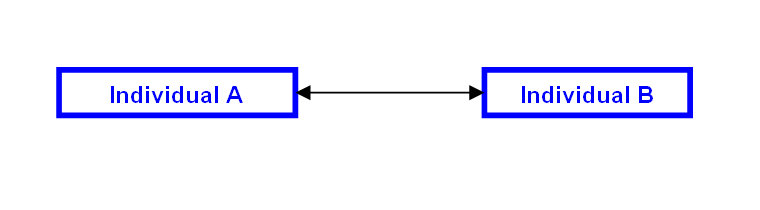
Individual A trades something in exchange for something from individual B. This, of course, is what we, as humans, do many times a day, every day. We exchange some kind of good or service for another good or service. We commonly exchange our labor for money, taking in the form of wages the wealth we helped to create. While money is often the unit of exchange, it doesn't have to be. Two mothers might exchange baby-sitting services so both have a chance to shop at a market and exchange even more.
In a free society, the terms of exchange are voluntary. Consequently, both sides of the exchange benefit from the trade or else the exchange would not occur. For much of the history of mankind, this exchange went on freely and spontaneously without outside interference. Then the state stepped in between the exchangers, looking something like this: 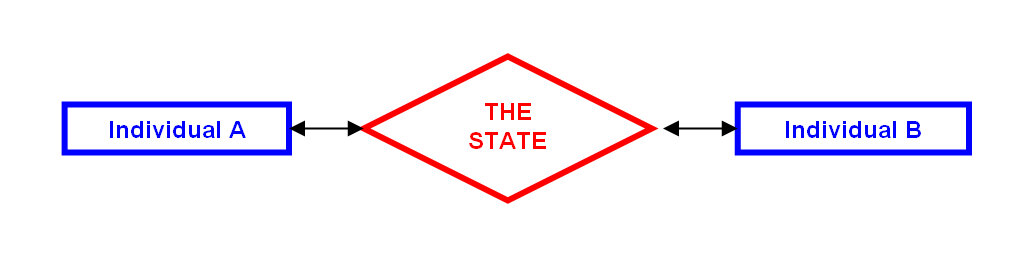
The state steps in to act as a mediator between the parties to the exchange. Rather than A and B negotiating the terms of the exchange, the state coercively dictates the terms. This incremental transformation of voluntary civil society into a coercive political society gradually controls the terms of exchange of most, if not all, markets and associations.
The most common mechanism employed by the state for controlling the terms of exchange is regulation. Regulation controls what products and services are or are not available for exchange in the marketplace, and what characteristics these products and services must have. Regulation is frequently a successful attempt by politically connected individuals or groups to employ the power of the state to block competitive entry into the marketplace in order to profit the few at the expense of the many.
Mechanism #2: One Thing Leads to Another
Austrian economist Ludwig Von Mises was one of the first to point out that state intervention in the market inevitably causes market distortions that require even further intervention until the state finally takes total control of the market. The health care market is an excellent case in point, starting with the introduction of Medicare, Medicaid and state mandates regarding what medical services private health insurance should cover. Another example is the perfect storm of government interventions over the years in the housing market, including the Community Reinvestment Act, Fed credit expansion, and government-sponsored agencies such as Freddie and Fannie; all leading to a boom and bust in the housing market followed by the state ultimately taking increased control of financial markets. Other examples abound, but space prohibits listing them here.
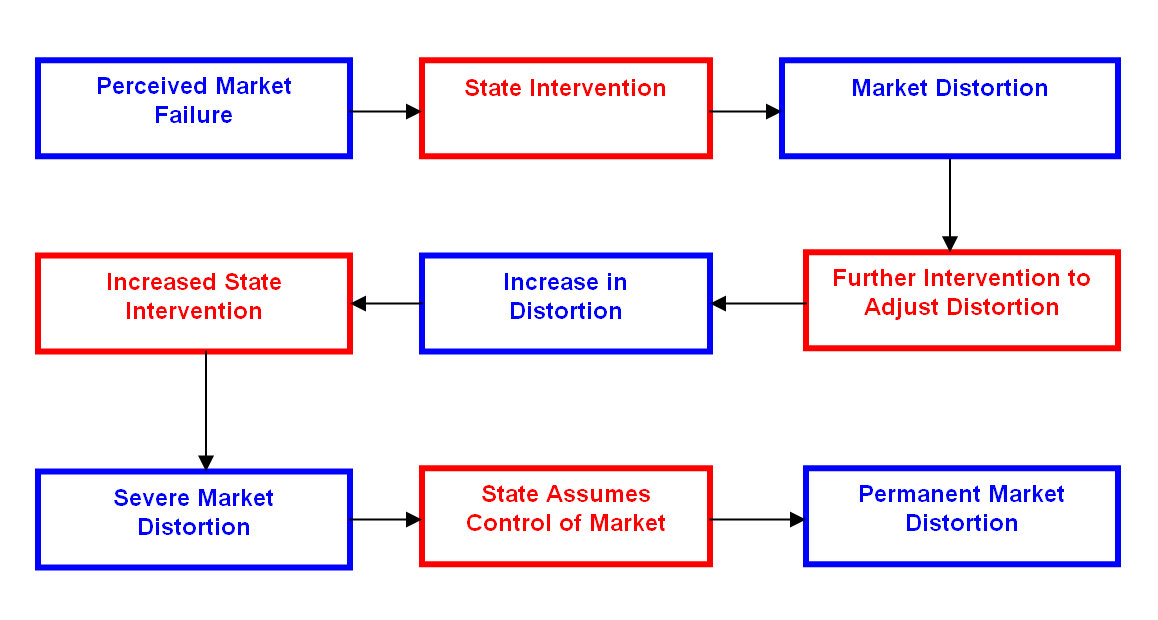
Market distortions caused by state intervention are often those of supply and demand. Interventions usually result in either a surplus or a shortage. The consumer experiences a shortage of goods or services either through long waiting lists, empty shelves or price increases. A surplus is an overabundance of a product or service, usually caused by subsidies, such as aid to farmers producing milk, potatoes and wheat. As a general rule of thumb, you get more of what you subsidize. If wheat growing is subsidized, you get an overproduction of wheat. If potato production is subsidized, there is an overabundance of potatoes. If poverty is subsidized, you get more poverty. Distortions in supply and demand cause disruptions in prices, which are then often controlled by the government through price caps or floors, causing the cycle to be repeated.
Mechanism #3: You Belong to Me
The third mechanism employed by the state is to assume responsibility for the consequences of our behavior, thereby giving the state authority to control the behavior causing the consequences for which it has assumed responsibility, as illustrated below.
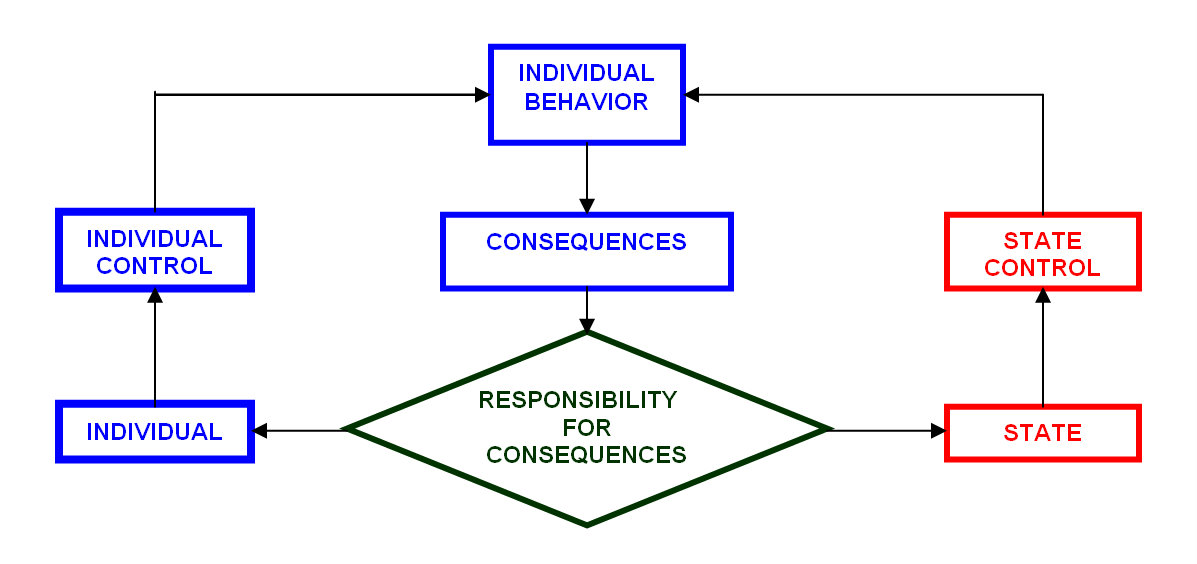
A current example is the discussion by the federal government to levy a tax on junk foods, allegedly to help allay government share of health care costs. As the state takes control of the health care market, we can expect increased control over any and all behavior that the state determines is a threat to our health and safety, factors that, of course, include most human activity. The reader, to be sure, will think of other examples that fit this model, too many to list here.
It's the Market or the State
Ultimately, there are only two ways to organize society, either by voluntary action on the part of individuals or by force. If the latter is chosen, the only entity that has the capacity to exert that magnitude of force is the state. If you believe that voluntary action is the principled way to order markets and associations in a manner consistent with natural liberty, then you have no choice but to oppose state coercion. Furthermore, there can be no such thing as a little state coercion to tweak societal inequalities. A little coercion is akin to being a little pregnant. Once given power, the state will expand its force to control what it can, using whatever mechanisms are available. As Mises wrote many years ago, the question is always the same: the market or the state? There is no third way.


 Print
PrintUser Login
Search This Site
Recent comments
-
No real surprise.
-
https://gx2527leftinvietnam.com/
-
https://www.infowars.com/posts/alert-col-macgregor-warns-dem...
-
And of course, both of the author/commentators are Jews. No...
-
Surprised to see Switzerland at only 32/100. Would've be...
-
https://www.infowars.com/posts/johns-hopkins-says-gun-contro...
-
An early Christmas present, it seems -- here, some 17 years...
-
Never Forget Building 7: https://www.infowars.com/pos...
-
Straight out of the communist playbook, as per Saul Alinsky...
-
It's certainly a step in the right direction.
more

Root Strikers
Non-Voting

Civil Disobedience





 Reprint Rights