"The whole aim of practical politics is to keep the populace alarmed (and hence clamorous to be led to safety) by menacing it with an endless series of hobgoblins, all of them imaginary." ~ H.L. Mencken

Dogs and Love, Part II
Exclusive to STR
April 23, 2007
"We are alone, absolutely alone on this chance planet: and, amid all the forms of life that surround us, not one, excepting the dog, has made an alliance with us." ~ Maurice Maeterlinck (1862 - 1949)
One way dogs and other animals illuminate the duality of love and freedom is by being the same as us, yet different. Ultimately, sameness is the reason for compassion and for most of love generally, while differences are the reason that freedom is necessary.
It is perhaps easier to see that we are all individuals, yet all the same when looking at "dogs versus people" instead of at people alone.f
Oneness
The sense of oneness comes from the sameness we share with others. For a start, the universe is composed of the same basic stuff (subatomic particles, atoms, molecules, etc.) everywhere -- the billions of other galaxies are made of the same things as our own, so far as we know. On Earth, all life forms have bodies based on carbon chemistry and DNA (including amazing levels of overlap even among very different species).
Higher-level similarities between "us" and "them" are very dramatic in the animal kingdom, and especially between humans and other mammals. For example, dogs and humans share many characteristics including:
-
- The need for air
-
- The need for water
-
- The need for food
-
- The need for a similar range of temperature and other environmental variables
-
- The need for companionship
-
- The need for affection
-
- The need for freedom of movement
-
- Fear, when triggered in (usually) appropriate situations
-
- Instinctive behavior to protect self and family from assault or other danger
-
- Sexual feelings, and propagation of the species via sex
-
- Life in utero, followed by birth, infancy, childhood, adolescence, adulthood, old age, and death
-
- Hair, teeth, nostrils, lungs, hearts, ears, eyes, and other body parts
-
- Aversion to pain and attraction to pleasure, with much overlap in terms of what causes each (e.g., burns hurt dogs as well as humans).
A human's experience of such things may be different from a dog's (or not; how could we know?) – but no matter: when your dog or cat is very thirsty and finally has a chance to drink, you probably cannot help but empathize with the animal's obvious pleasure at satisfying its thirst; watching the animal eagerly drink reminds you of the thousands of times you have done the same. You remember, perhaps, the stark pleasure of gulping down a liter of cool water after a 5K run on a warm day. These seemingly shared experiences are part of the bond between you; they remind that you and the animal are one – that you are both the same in important ways despite your differences.
Individuality
We do not expect ants or bees, or even amphibians or reptiles, to show distinct individual personalities (although they surely must have such differences, however small), but in mammals, each individual is clearly unique. Among human beings, this effect is strong enough to balance the sense of oneness, literally creating the duality of love and freedom in our lives.
The differences between dogs and humans are obvious, and for that matter each dog has its own unique personality. Our small dog Zoomer is fearless and friendly when meeting new people, yet one of his litter-mates was shy and hiding beneath a chair at the breeder's house while Zoomer was jumping in our laps and licking our faces. Zoomer at 12 weeks old couldn't be kept away from us, while his brother wouldn't come near.
People are so different from one another that sweeping statements about large groups are usually wrong. Take an obviously universal and fundamental characteristic from the list above, for example the need for food, and note that humans differ even here, at least in their expression of the need and in their evident experience of it.
At the extreme, an anorexic person may experience the sight or thought of food as unpleasant and unwanted even when the body is literally starving. Food is required for life, yet an anorexic may refuse to eat even when visibly near death.
Individual differences are highlighted frequently by contrast with statistics and probabilities. For example, take the statement "men are taller than women."
Is that true? On a statistical level, yes: On average, men are about five inches taller than women. Yet there are many women taller than the average man, and many men shorter than the average woman. At any gathering, one is likely to see some women taller than at least some of the men who are present. Clearly, the statement "men are taller than women" is often wrong when applied to specific men and women. Individual differences in height render such statements useful only in the statistical sense.
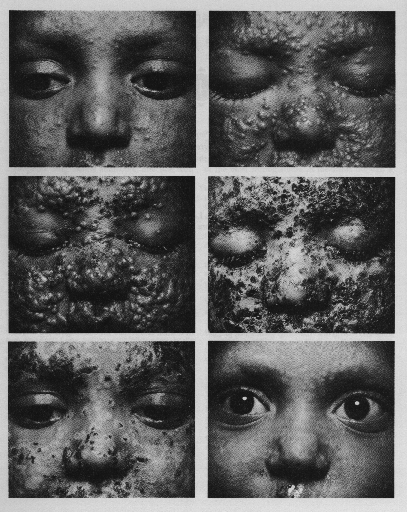
People differ in their preferences and abilities, in their strengths and weaknesses, in their physical characteristics, and in their attitudes and desires. These differences are important in life; they are not mere curiosities. Individual differences play a key role in the division of labor, which is to say they allow for civilization itself. To understand this, it helps to reflect upon the vast number of things that people do in and out of the market, from open-source programming to pro-bono legal work, from logging hardwoods to designing kitchen appliances, from brain surgery to garbage collection. The list of things that need doing to create and maintain civilization is immense, and if people were all exactly the same, much of it would never get done. Were that the case, you and I would be living in an eternal Stone Age instead of reading and writing this column on our computers. Smallpox [fair warning: link is to a photo of a smallpox victim] would still be a commonplace horror; cooking and "central heating" (if they existed at all) would involve a fire inside our cave (imagine the smoke!). Nearly everything we rely on today – food at the market, electric power, modern medicine and dentistry, office supplies, rapid communication over any distance, and so many other things – would be impossible without the highly complex, fine-grained division of labor.
Our differences are what make us who we are, and thus when our uniqueness is denied, we feel disrespected. This is one reason that freedom is important: non-freedom (coercion) is an assault on our very nature. The practical consequences of denying human individuality are catastrophic, partly because of damage it causes to the division of labor (and thus to human health and prosperity) and partly because denial of this element (uniqueness) in human nature leads inevitably to cruelty. A person not allowed to express him- or herself is, by definition, being forced to live a lie. People naturally rebel at being forced to deny their own true nature, leading to the "need" for ever-harsher repression to enforce the denial of individuality. Eventually, one reaches a level where cruelty and absurdity are both at dizzying heights, as when terminal cancer patients are put in prison for using a safe, natural plant to alleviate their suffering or to help keep their food down when chemotherapy is making them nauseous.
Love and freedom: as I keep saying, we'll have both, or we'll have neither.
- - - - -
By being so clearly different-yet-the-same, dogs can help us to see and better understand this crucial, central duality of love and freedom. By being so vividly loving and affectionate, dogs remind us that our "sameness" with other beings provides a natural foundation for love. By being so loving despite also being vicious carnivores, dogs offer hope that even a species as violent as our own can choose love and peace over hatred and violence. By the example of well-treated puppies growing into healthier and less violent adult dogs (than their badly-treated cousins), dogs also point the way to such an improvement in the human condition.
In all, dogs thus present us with a strongly optimistic view of life, and this is yet another reason to cherish them.


 Print
PrintUser Login
Search This Site
Recent comments
-
No real surprise.
-
https://gx2527leftinvietnam.com/
-
https://www.infowars.com/posts/alert-col-macgregor-warns-dem...
-
And of course, both of the author/commentators are Jews. No...
-
Surprised to see Switzerland at only 32/100. Would've be...
-
https://www.infowars.com/posts/johns-hopkins-says-gun-contro...
-
An early Christmas present, it seems -- here, some 17 years...
-
Never Forget Building 7: https://www.infowars.com/pos...
-
Straight out of the communist playbook, as per Saul Alinsky...
-
It's certainly a step in the right direction.
more

Root Strikers
Non-Voting

Civil Disobedience





 Reprint Rights