"The whole aim of practical politics is to keep the populace alarmed (and hence clamorous to be led to safety) by menacing it with an endless series of hobgoblins, all of them imaginary." ~ H.L. Mencken

The Two Million Dollar Sportfish
Exclusive to STR Water terrifies me. Not the liquid, mind you, but the mystery and inherent power of deep water. What lurks there? Whenever I am caught in a storm at sea I feel the frailty of a man poised before an abyss. Certainly deep water is calmer; storms and tidal surges cause far more damage in shallow water, but it is the deep, dark water that seems most terrifying. 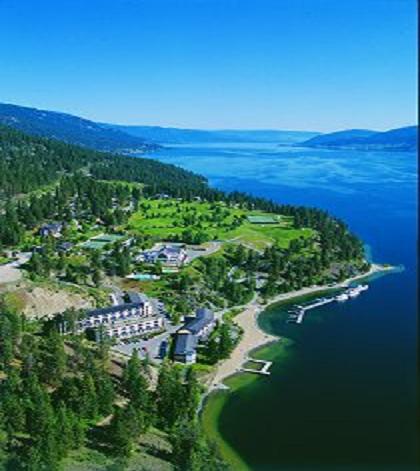 Nearly 1,000 feet deep, Okanagan Lake, in British Columbia, Canada, is one of the deepest lakes in North America and perhaps the most mysterious. Not simply for the deep water but for what lurks there. Down in the depths, gliding like a ghost in the ninety-mile long lake, swims a mythical sea creature. Called the 'Canadian Loch Ness Monster,' the creature surfaces from time to time and, like the Scottish sea creature, is sometimes seen but rarely photographed. In August I windsurfed across the three miles of windswept water from Peachland to Squally Point. The wind funnels, or squalls at times, through the serpentine gorge of this freshwater sea, the cliffs rising several hundred feet to forms plateaus at the foot of rugged mountains. I had come here to sail this magnificent lake and perhaps glimpse the creature that lived here. According to legend, and several eyewitnesses, N'ha-a-itk, or Ogopogo, lived in a submerged cave below the cliffs of Squally Point. Before I sailed I consulted my guidebook and chart for Squally Point. 'Stay clear of rock walls and watch for south winds but good shelter is provided from northwest winds in the south bay. No beaching for one quarter mile south or north.' Reading further I noted this chilling remark. 'Divers: qualified divers only. A cavern entrance that can be explored lies 100 feet from the point and 20 feet down. Take lights and be cautious.' Halfway across to Squally Point, I fell once in the brisk wind and choppy water. Almost before submersion, I leapt back aboard the board, shivering despite the warmth of the day. Suppose I came face to face with the creature while submerged? According to one report, Ogopogo had pulled a pair of swimming horses underwater and drowned them. What would he do to a sailor armed only with waterproof camera? I carried a camera for good reason. The local chamber of commerce realized the promotional value of Ogopogo. For one year they offered a two million dollar bounty for proof of his existence (since expired). University scientists would verify the claims'if any--and Lloyds of London would insure the event. A searcher signed an agreement stating he would (1) conduct the search on Okanagan Lake, (2) cause no harm or stress to Ogopogo, (3) comply with all water safety rules and regulations, (4) accept all committee judgments as final. With only a few weeks to go in the promotion, no one had claimed the prize. I filled in an entry form at the Kelowna Chamber of Commerce with a giddy sense of optimism. Tourist counselor Bridget Gumpert smiled and told me, 'You must have verifiable proof but you mustn't harm or capture Ogopogo.' Done deal, I thought. With a waterproof camera strapped to my wrist and my swift and silent windsurfer, the whole operation seemed simple. I would glide silently up to a slumbering sea creature basking in the sun and, before he realized what was happening, snap off a series of photos. If everything went according to plan, I'd have three or four close-up photographs--headshot, dorsal fins and a look of astonishment on sleep-glazed eyes--before the finny legend slipped beneath the waves. What did my quarry look like? Dark green to brown in color, a reptilian rather than fish-shaped body, 20-70 feet long, with a chisel-shaped head, resembling that of a goat or horse, atop an arched neck. According to some eyewitnesses, the creature displayed an aversion to powerboats yet an almost intelligent curiosity. 'All of a sudden I heard a swish of water,' said Mrs. Ruth Richardson, describing her sighting from the lakeshore. 'I looked out on the water and here was this Ogopogo sitting up there as big as life. He stood about three feet of him out of the water; he was quite a way out in the water but was very still and looking at me as though I was as big a curiosity to him as he was to me.' Ruth was ten years old at the time and, like most children, naturally curious. 'I watched for quite a while, and then he went down in the water; he rather backed down. So then I thought that was all of him and went on playing. Soon there comes another swish of water and he was much too close and he frightened me terribly. Well, that was just too much and I run to the house, you can be sure.' Ogopogo'the whimsical name given to this living fossil--was a marine animal whose ancestors had probably been around for millions of years. Survival depended on stealth, swiftness and cunning. With over 100 square miles of water and 270 miles of shoreline, Ogopogo could be anywhere. I felt honored to share the same element with such an illusive dinosaur, a virtual magician gamboling in a world where the predations of mankind stacked the odds heavily in favor of extinction. Where'or what--was Ogopogo? Frank Lillquist, a Kelowna newspaper reporter, compiled a list of ancient, supposedly extinct, sea creatures that could be related to the one in Okanagan Lake. 'Ogopogo sounds like it could be some kind of Plesiosaurus, which first appeared in the Rhaetic and was last seen in the Upper Cretaceous'last seen that is except for maybe one inspired member of the dying tribe who found refuge in a deep cavern of our lake.' I preferred to take a more optimistic view of Ogopogo. I preferred to think of this underwater anachronism as thriving rather than dying. Perhaps entire family units frolicked happily hundreds of feet below our so-called civilized world, in a realm as uncharted as the dark side of the moon. Perhaps only the elders of the species ever peeked their heads above the waves. Perhaps they thought of us as distant relatives who had gone astray--an evolutionary dead end'and in their eyes we humans were worthy only of observation and yes, sympathy. I envied this deep dweller. And thus, as I sat upon my sailboard, I tried to think like a fish. Where would I go on an unseasonably warm day? If I were a fish, where would I go to startle a few tourists and unnerve motorists while lazily shading myself? I looked at my map and considered various capes and bays. Where would a fish go to kick back and cool his fins? Of course! When in Kelowna, they probably went to the floating bridge. In 1926, the government declared that the new ferry being built to cross the lake would be equipped with special 'monster repelling devices.' There were no reports of any monsters ever being repelled. Sadly, what we cannot tame, we try to kill; what we cannot kill, we demonize. In time'with wisdom'we learn to respect, admire and preserve, if we are lucky and it's not too late. When the Kelowna floating bridge was open to traffic in 1958, it was the first of its kind in Canada. Sightings increased from the mile-long roadway. In August of 1989, John Kirk and three witnesses observed a creature with three humps swimming toward the floating bridge. After a few minutes, the animal dived, and when Kirk saw it again, the creature had changed direction. Slowly, Ogopogo was becoming less monstrous, less mythic terror, and instead a more compelling, almost fascinating civic attraction. Statues, postcards, even inflatable replicas of this once-fearsome creature appeared everywhere. But where, I wondered, was the real Ogie? At the Shelter Bay Marina, west of the floating bridge, I launched my sailboard and sailed across the lake beside the bridge. The city of Kelowna, population nearly 200,000, shares the same day-to-day problems as most urban boomtowns. That afternoon, traffic crawled in both directions on the roadway while a swarm of powerboats raced beneath the spans, adding to the din and feeling of congestion. Only a truly gregarious'or suicidal--sea monster would have risen to the surface of the lake that afternoon. Is the lake'big as it is'big enough to sustain Ogopogo? 'If Ogopogo is a species of Plesiosaur,' added Frank Lillquist, 'this breed ate mostly fish, but with Kokanee (a game fish) dying by the hundreds of thousands and pollution cutting into all fish populations, perhaps there isn't enough seafood left to sustain the brute.' 'Fish are the litmus paper of life in the lake, and what's happened to the Kokanee is a good reflection of what's going on with the water,' said Leonard Fraser of the Canadian EarthCare Society. Various sightings of Ogopogo have reported the creature in what appears to be pursuit of fish. Kokanee have declined to just 10% of 1970 levels. Meanwhile, B.C. Environment has introduced a test fishery using two trawlers. Although I tried for an entire afternoon, I never caught a glimpse of Ogopogo, but I was awestruck by his home in Okanagan Lake. I wanted to see a marine dinosaur with a horse's head, as legendary as any unicorn, but it wasn't to be. Perhaps in the future we shall read a news report of an unknown species of fish, long presumed extinct, dredged up in a Canadian fishing net. One can only hope that, following the whoops of astonishment and endless photographs, catch-and-release occurs before Ogopogo expires. When something wild dies, a little bit of wilderness dies in us all, and the world becomes tamer but not necessarily greater.


 Print
PrintUser Login
Search This Site
Recent comments
-
No real surprise.
-
https://gx2527leftinvietnam.com/
-
https://www.infowars.com/posts/alert-col-macgregor-warns-dem...
-
And of course, both of the author/commentators are Jews. No...
-
Surprised to see Switzerland at only 32/100. Would've be...
-
https://www.infowars.com/posts/johns-hopkins-says-gun-contro...
-
An early Christmas present, it seems -- here, some 17 years...
-
Never Forget Building 7: https://www.infowars.com/pos...
-
Straight out of the communist playbook, as per Saul Alinsky...
-
It's certainly a step in the right direction.
more

Root Strikers
Non-Voting

Civil Disobedience





 Reprint Rights