"The whole aim of practical politics is to keep the populace alarmed (and hence clamorous to be led to safety) by menacing it with an endless series of hobgoblins, all of them imaginary." ~ H.L. Mencken

Hollywood Invasion!
Does the Pentagon--the Department of Defense, Joint Chiefs, Rummie, Wolfie--ever watch war movies? I'm sure they do, but wouldn't it be truly worthwhile if our leaders left the theatre with a view of the Bigger Picture? With that idea in mind, I suggest three very good Hollywood war movies that offer the astute moviegoer (and war planner) all the things he should look for in a war film: action, suspense, good story, excellent performances, moral questions as well as bittersweet moral lessons.
Black Hawk Down: An American War Story began as the written account of a disastrous assault in Mogadishu and became the basis for a movie of the same name. "Black Hawk Down," the tragic, true story of US military involvement in Somalia occurred over ten years ago, in October 1993, but the memory is never far from urban war planners today. The bloody loss of life, the shifting objective from humanitarian aid to rescue without incurring additional losses, sent Pentagon brass back to the drawing board. Today, US field commanders in Fallujah and Baghdad no doubt coordinate troop movements with the Black Hawk disaster well in mind.
The movie begins with a hasty, humanitarian mission to relieve starvation in war-torn Somalia, but our good intentions yielded deadly results. U.S. soldiers entered Somalia, wading ashore triumphantly, on an exercise that was supposed to take about a few hours. The mission quickly turned into a running gun battle against thousands of heavily armed Somalis. Eighteen U.S. soldiers and 500 Somalis were killed (and over 1,000 wounded) as a result of the conflict.
I have to agree with Mickey Kaus when he says, in an excellent feature, "Everyone should see it. See it twice, actually'it takes repeat viewings to comprehend the rush of characters and events." What I don't agree with is the need to be there in the first place. Kaus rightly points to the failure of the UN to prevent a chaotic situation from becoming a bloody confrontation. Nothing was solved by Delta Force--unless you count the loss of over 500 human lives as a solution to a problem.
 To its credit, the movie vividly portrays the bloody conditions and the chaos of urban battle, which every American teenager with military ambitions should see, but the characters in the movie are seldom more than sketches, as noted. The Somalis themselves are portrayed with about as much depth and understanding as Klingons in those old Star Trek TV episodes. Too often Hollywood portrays "the enemy" as cardboard targets--one dimensional personifications of evil--and Black Hawk Down (2001) is no exception. The most commendable aspect of the movie, however, is that it does not glorify war. The pitched gun battles have a terrifying reality, and we realize we cannot always remake the world with superior firepower, extreme bravery and good intentions, no matter how ideally conceived.
The fallout from the actual downing of the UH-60A Black Hawk utility helicopter and the vivid CNN television exposure--a mutilated US trooper dragged through the streets--sent the Clinton administration backpedaling from the fiery confrontation in Somalia (but not Waco), much like the demolished US Marine barracks and the death of 241 sleeping Marines sent Ronald Reagan packing from Lebanon exactly ten years before. Maybe we need to get our nose stung every ten years to relearn how to stay out of hornet's nests.
What lessons were learned from the Somalia disaster? Get better intelligence! Obviously we saw one lesson that had been learned in Fallujah (avoid street battles) but another, obvious and equally deadly lesson, that appeared vividly throughout most of "Black Hawk Down" was ignored: Our Humvees had shitty armor then, and were never improved before the invasion of Iraq--at great cost of life.
One of my favorite movies is a moral lesson, war movie and adventure story, all rolled into one entertaining yet exasperating package. Besides being a modest Hollywood success story, "Three Kings" was only the third film made by director David Russell. You understand early that Russell intends to tilt at windmills and examine some uncomfortable themes that our so-called free press sidestepped during Gulf War One. Purposely shot on a blue-toned, ektachrome film,"Three Kings" has an oppressive, sunblasted look, almost as if all that depleted uranium in the air had suddenly become visible. Below the surface of this rollicking, "buddy movie" lurks a perfectly subversive, even-handed, antiwar film with excellent and believable performances.
There aren't any good guys, the movie almost seems to suggest, only selfish ambitions overruled occasionally by our better intentions.
"'Three Kings' asks the hard questions about the numerous military actions the United States has spearheaded during the second half of the 20th Century," says Hollywood critic James Berardinelli. "For instance, what is the motivation behind the attack? Regardless of where it is, Vietnam, Grenada, Kuwait, the Balkans, are we fighting for legitimate political or humanitarian reasons, or is it all an attempt to boost patriotism and TV ratings? . . . . And, in this sanitized environment, do we ever consider the real, human cost on the civilian population of the so-called 'enemy'? In one way or another, 'Three Kings' delves into these issues, but the script has enough integrity and intelligence not to provide the answers."
One unanswered theme of "Three Kings" is how much blame to assign to elder Bush for his exhortation to the Kurds and Shiites to "rise up" against Saddam following the retreat of the Iraqi army from Kuwait. Withholding critical US air support to the uprising--to the exasperation of many US military commanders--allowed the Iraqi Republican Guard to massacre the Shiites and Kurds. This betrayal becomes a powerful thread throughout the film and leaves many difficult, unanswered questions. The understandable resentment of the Shiites for this betrayal, despite the toppling of Saddam Hussein twelve years later, cannot easily be remedied and their trust gained except by our departure. The movie ends with a poignant climax during a scene of military and political posturing and leaves you wondering whether film director Russell once served in the Middle East as a foot soldier. He certainly seems to understand the morass of Iraq very well.
The Beast (1988) is an excellent, little-publicized war movie about a lesser-publicized war. A small, tenacious band of CIA trained-and-backed Afghan Mujahedeen fighters (future Taliban and Al Qaida "terrorists") wage a cat-and-mouse battle with a Russian tank, armed only with a few AK-47s and a broken RPG. The opening battle scenes are some of the most harrowing and yet believable caught on film. When I watched the Soviet T-62 tanks smash a poor, remote mountain village, I immediately thought of our attacks on comparable Iraqi villages last week, a decade after the Soviets were defeated. Obviously, no lessons have been learned by our Pentagon war planners from this 14 year-old movie--unless they are the wrong ones. One of the supreme ironies of "The Beast" is that it was shot on location in the desert of Israel. Not surprisingly, our strategy in the Middle East is lifted directly from that of the defeated Soviets and the brutal Israelis.
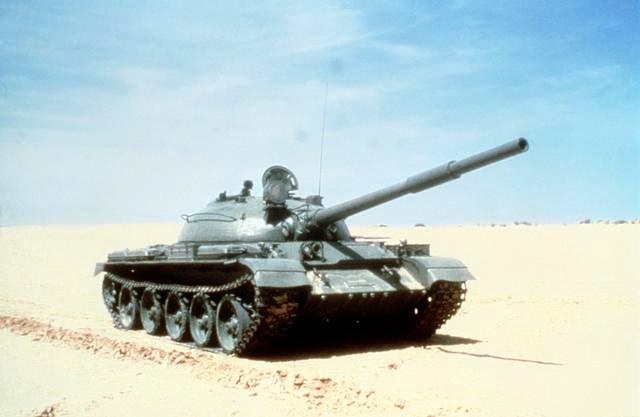 The Beast in the movie is a Soviet T-62 tank (pictured at left), driven with effective brutality by a Russian field commander named Daskal, portrayed by George Dzundza in an Oscar-worthy performance. Daskal has one mission: To literally crush the opposition. If you rent this increasingly difficult-to-find film, you will view an Afghan resistance fighter being purposely crushed to death beneath the tank treads--a frightening reminder of what happened to American Rachel Corrie recently in Israel. The Beast, you quickly realize, is both the bone-crushing Soviet tank and the bone-crushing viciousness of military occupation.
Interestingly, the "hero"--in Hollywood terms--is a dissident Russian tank mechanic who opposes the brutality of his commander, Daskal. For his sentiments, Koverchenko, played by Jason Patric, is abandoned to the elements and the vengeance of our former freedom fighters. Rescued by them, he turns against his brutal Communist comrades and joins the hunt for the slowly disintegrating tank. I couldn't watch The Beast--a movie I've seen several times--without thinking that conquering armies learn very little from the examples of other defeated armies before them. The British and Soviets both followed the Greeks into disaster there, and we are the fourth superpower to try. The Afghans lost two million people in the ten year war with the Soviets but, thanks to the RPGs and a thousand Stinger missiles provided by the CIA, plus the training of such men as Special Forces Colonel Bo Gritz, they finally defeated the Russians.
Does disaster await us in the Middle East? God--or Allah--only knows. Do the Pentagon planners know the meaning of the word hubris? From almost all indications, they do not. Perhaps, on a slow afternoon, these three movies might be studied for clues and errors to avoid. But for the moment, I fear my country is like that wheezing Soviet tank, stalked by a relentless reckoning we've mistaken for terrorism.


 Print
PrintUser Login
Search This Site
Recent comments
-
No real surprise.
-
https://gx2527leftinvietnam.com/
-
https://www.infowars.com/posts/alert-col-macgregor-warns-dem...
-
And of course, both of the author/commentators are Jews. No...
-
Surprised to see Switzerland at only 32/100. Would've be...
-
https://www.infowars.com/posts/johns-hopkins-says-gun-contro...
-
An early Christmas present, it seems -- here, some 17 years...
-
Never Forget Building 7: https://www.infowars.com/pos...
-
Straight out of the communist playbook, as per Saul Alinsky...
-
It's certainly a step in the right direction.
more

Root Strikers
Non-Voting

Civil Disobedience





 Reprint Rights